💳 Money & Payments

How to pay in Korea, what to carry, and a planner to estimate what your trip will cost.

How do cards, cash, ATMs and currency exchange work in Korea?

Korea is a very card-friendly country. Hotels, department stores, convenience stores, cafés and restaurants take cards, and many small shops do too, so you do not need to carry your whole travel budget in cash.

The Korea Tourism Organization says credit cards are widely used at hotels, department stores and most shops, and that international cards such as Visa, Mastercard and American Express can be used. Not every shop approves every foreign-issued card, though.

The easiest setup
Two cards that work abroad + a little Korean won (KRW) + an ATM when you need more
Do not rely on a single card. Carry two different cards and some cash in case a payment fails or a card is lost.

Quick answers

Can I use my foreign credit card in Korea?Yes.

Foreign credit cards work at most hotels, shopping malls, convenience stores, cafés and restaurants. Not every shop supports every foreign card, so bring a backup card and a little cash.

Do I need cash in Korea?A little cash is recommended.

Cards cover most payments, but traditional markets, small shops and transit card top-ups can be easier or only possible with cash.

Can I withdraw Korean won from an ATM?Yes.

Use a Global ATM or an ATM that accepts international cards. Look for the Visa/PLUS or Mastercard/Cirrus marks on your card and on the machine.

Should I choose KRW or my home currency?Choose KRW.

Choosing your home currency turns on Dynamic Currency Conversion (DCC), where the ATM or shop operator’s exchange rate and extra charges can apply.

Can I exchange money at Incheon Airport?Yes.

Incheon Airport has bank exchange counters and ATMs, and some counters are open 24 hours. Hours differ by terminal, so check before you arrive.

Cards

How well do cards work in Korea?

For most everyday payments you can simply use a card. Cards are very convenient at:

  • Hotels, department stores and shopping malls
  • Convenience stores, cafés and chain restaurants
  • Most ordinary restaurants and large supermarkets
  • Attractions, taxis and pharmacies

Visa and Mastercard are the networks travelers can use most easily, and some places also take American Express and others.

One thing to keep in mind: a shop that takes cards is not always a shop that approves YOUR foreign card. Some small payment systems and unattended kiosks only process Korean-issued cards, and some foreign cards are declined because of how they are authenticated. That is why you should not rely on a card alone.
Check your card before you travel

Open your card app or call your bank and check these points before you leave:

  • International transactions: some issuers block overseas payments by default or ask you to turn them on.
  • ATM withdrawals: a card that works abroad for payments may still be blocked for overseas ATM cash.
  • PIN: make sure you remember the PIN you will use at ATMs.
  • Foreign transaction fee: ask what your issuer charges for overseas payments and currency conversion.
  • Cash withdrawal fee: your bank may charge its own fee for overseas ATM withdrawals.

Do not bring just one card

One of the worst travel moments is a card that suddenly stops working. A fraud-detection system can block an overseas payment, or the terminal and the card may not agree on how to process it.

We recommend a primary card (for example a Visa or Mastercard you normally use) and a backup card from a different bank or a different card network, such as Visa + Mastercard. Keep the two cards in different places, not in the same wallet, in case one is lost.

Cash

Do I need cash in Korea?

Yes, a little. Korea is very card-friendly, but we do not recommend traveling with no cash at all. Cash is still useful or needed for:

  • Some traditional markets and street stalls
  • Very small restaurants and some local shops
  • Transit card top-ups and some unattended machines
  • When card payments are down, or your foreign card is not approved

If you plan to use a transit card, bring some cash: Tmoney tells foreign visitors that some top-up machines accept cash only.

How much cash should I bring?

You do not need to bring your whole budget in cash. Prepare a small emergency amount for when you arrive. As a practical suggestion, ₩50,000 to ₩100,000 covers a transit card top-up, small shops, snacks and surprise card problems.

This is not an official figure, just a sensible starting point for most travelers. If you need more, withdraw it from an ATM that accepts international cards.

Korean money

Korea’s currency is the Korean won. Its code is KRW and its symbol is ₩. The Korea Tourism Organization also lists the won as the official currency.

Approximate reference rate. Check the current rate before you exchange money.

Banknotes

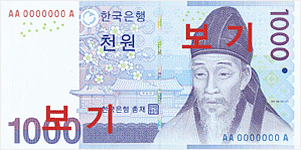
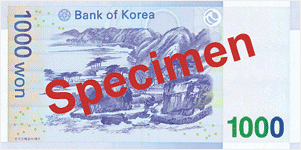
  • 1,000 won banknote, front (specimen)1,000 won banknote, back (specimen)
    ₩1,000
    1,000 won · 136 × 68 mm
    ≈ $0.72 (USD)
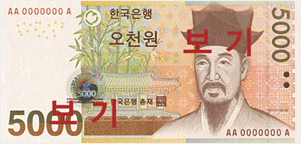
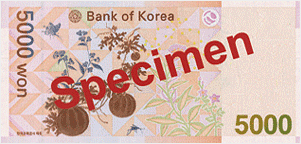
  • 5,000 won banknote, front (specimen)5,000 won banknote, back (specimen)
    ₩5,000
    5,000 won · 142 × 68 mm
    ≈ $3.62 (USD)
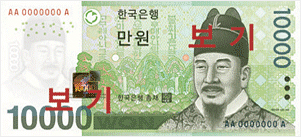
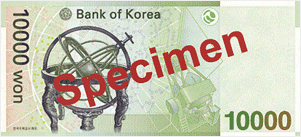
  • 10,000 won banknote, front (specimen)10,000 won banknote, back (specimen)
    ₩10,000
    10,000 won · 148 × 68 mm
    ≈ $7.25 (USD)
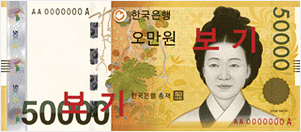
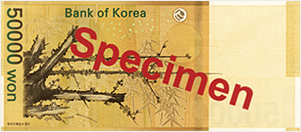
  • 50,000 won banknote, front (specimen)50,000 won banknote, back (specimen)
    ₩50,000
    50,000 won · 154 × 68 mm
    ≈ $36.23 (USD)

Coins

  • 10 won coin, front10 won coin, back
    ₩10
    10 won
    ≈ $0.0072 (USD)
  • 50 won coin, front50 won coin, back
    ₩50
    50 won
    ≈ $0.036 (USD)
  • 100 won coin, front100 won coin, back
    ₩100
    100 won
    ≈ $0.072 (USD)
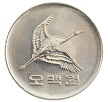
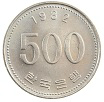
  • 500 won coin, front500 won coin, back
    ₩500
    500 won
    ≈ $0.36 (USD)

The largest banknote in circulation is ₩50,000.

Images: Bank of Korea specimen images. The designs of Korean banknotes and coins are copyrighted by the Bank of Korea. Banknotes are shown front and back, at 75% of actual size or smaller, with the Bank’s own “보기” (front) and “Specimen” (back) marks left in place, following the Bank’s currency design use standards. Bank of Korea: currency design use standards

KRW Currency Converter

ATMs

Can I withdraw cash from a Korean ATM with a foreign card?

Most travelers can withdraw won with an international card. But not every ATM supports every foreign card.

When you look for an ATM, check the screen or the machine for these signs:

  • Global ATM
  • International Cards
  • Visa / PLUS
  • Mastercard / Cirrus

Visa says its PLUS-marked international ATMs let eligible Visa cards withdraw local currency. Many ATMs at major Korean banks offer an English menu, and some banks offer several foreign languages.

Find an ATM at Incheon Airport

Incheon Airport has an official facility finder with a map. You can search it for ATMs, exchange counters and any other facility.

  1. 1Open the Incheon Airport facility finder with the button below. It is the official map of Incheon International Airport.
  2. 2Type “ATM” in the search box and press Enter.
  3. 3The results list each place with its terminal, floor and a nearby landmark such as a gate, exit or check-in counter. Counters that are open around the clock are marked “24H”.
  4. 4Use the Terminal 1, Terminal 2 and Concourse tabs under the search box to narrow the list, then tap a result to see it on the map.
  5. 5Arrival hall counters are on the 1st floor (1F) and departure hall counters on the 3rd floor (3F). If you have just landed, look for the arrival hall ones.
  6. 6To find any other facility, such as a pharmacy, a SIM card counter, luggage storage or a lounge, type its name in the same search box.
Open the Incheon Airport facility finder

Other airports

Korea Airports Corporation runs these airports. Each page has a facility list and map: choose the terminal and floor, then use the keyword box or the categories. Try “ATM”, “bank” or “exchange”, and check opening hours in the list.

How to withdraw cash, step by step

  1. 1Choose English on the ATM.
  2. 2Choose “Foreign Card”, “International Card” or a similar menu.
  3. 3Insert your card, or follow the on-screen instructions.
  4. 4Choose “Cash Withdrawal”.
  5. 5Enter your PIN.
  6. 6Choose or type the amount you want.
  7. 7Check the fee and exchange-rate information shown on the screen.
  8. 8Take your cash, your card and the receipt.

Screens and menus differ a little from one ATM to another.

ATM fees: what you may pay

A foreign card used at a Korean ATM can trigger more than one fee:

  • The Korean ATM fee, charged by the ATM operator
  • Your own bank’s fee for overseas withdrawals
  • A currency conversion or foreign service fee from your card issuer

Always read the fee shown on the ATM screen before you accept it. If your card charges a fee per withdrawal, taking out a planned amount can cost less than many small withdrawals. Do not carry a large amount of cash, though: only withdraw what you need.

KRW or your home currency? Choose KRW

This is the most important tip for foreign visitors. A Korean ATM or card terminal may ask:

“Pay in KRW?” or “Pay in USD / EUR / GBP / JPY?”

This is Dynamic Currency Conversion (DCC). For example, if a US traveler pays ₩100,000, the ATM or merchant may offer to charge the equivalent in US dollars right now, using its own exchange rate. According to Visa, a DCC rate can include an extra fee or markup, while paying in the local currency uses your card issuer’s rate.

In Korea, choose KRW (Korean won) at ATMs, hotels and shops, which means paying in the local currency. Your real cost still depends on your own card’s foreign exchange terms, so check them. If a shop offers to charge your home currency, you can say: “Charge me in KRW, please.”

Choose KRW when you pay by card, too

Hotels and shops can also ask you to choose between KRW and your home currency on the card terminal. Do not pick your home currency just because it looks convenient: check the exchange rate and any extra cost first. Visa warns that converting to your own currency on the spot (DCC) can include extra charges. Unless you have a specific reason, pay in KRW.

Currency exchange

Where can I exchange money?

You can change foreign currency into won at:

  • Airport exchange counters, such as the bank counters at Incheon Airport
  • Banks in Korea
  • Authorized currency exchange offices

The Korea Tourism Organization advises using banks or authorized exchange offices.

Can I exchange money at Incheon Airport?

Yes. Incheon Airport has exchange counters and ATMs from several banks, including KB Kookmin, Woori and Hana. Some counters are open 24 hours, but locations and hours differ by terminal, so if you arrive late at night or early in the morning, check which counter is open.

A simple approach is to exchange just enough for your first needs at the airport, then compare rates and fees for anything more.

Find an exchange counter at Incheon Airport

Incheon Airport has an official facility finder with a map. You can search it for ATMs, exchange counters and any other facility.

  1. 1Open the Incheon Airport facility finder with the button below. It is the official map of Incheon International Airport.
  2. 2Type “exchange” (or “Currency Exchange”) in the search box and press Enter.
  3. 3The results list each place with its terminal, floor and a nearby landmark such as a gate, exit or check-in counter. Counters that are open around the clock are marked “24H”.
  4. 4Use the Terminal 1, Terminal 2 and Concourse tabs under the search box to narrow the list, then tap a result to see it on the map.
  5. 5Arrival hall counters are on the 1st floor (1F) and departure hall counters on the 3rd floor (3F). If you have just landed, look for the arrival hall ones.
  6. 6To find any other facility, such as a pharmacy, a SIM card counter, luggage storage or a lounge, type its name in the same search box.
Open the Incheon Airport facility finder

Other airports

Korea Airports Corporation runs these airports. Each page has a facility list and map: choose the terminal and floor, then use the keyword box or the categories. Try “ATM”, “bank” or “exchange”, and check opening hours in the list.

Use banks or licensed exchange offices

Stick to banks and licensed exchange offices. Incheon Airport also tells travelers not to use unregistered exchange services and to use the airport’s official banks and authorized exchange services.

Never exchange with someone on the street, even if they offer a good rate.

What you need to exchange money

Bring your passport: depending on the place and the amount, you may be asked for ID. Before you exchange, check:

  • The exchange rate
  • The commission or service fee
  • The amount you will actually receive
  • Which currencies and notes they accept

The same currency can have a different rate and fee at different counters. Do not look only at “0 commission”: the number that matters is the final amount of won you receive.

Can I exchange old foreign banknotes?

Not always. The Korea Tourism Organization says some banks and exchange offices may not accept old foreign banknotes. Bring notes that are in good condition and recently issued.

Putting it together

A setup that works for most travelers

Main payments
Credit / debit card
Transport and small purchases
A small amount of KRW cash + a transit card
More cash
An international ATM when you need it

Rather than exchanging a lot of cash and carrying it around, use a card for most things and cash as a backup, as much as you need.

A transit card is not the same as a credit card

Many visitors use a prepaid transit card such as Tmoney for subway and bus rides. A standard Tmoney card also works on some taxis and at some convenience stores.

Do not treat paying by card and topping up a transit card as the same thing: some top-up machines take only cash, so keep a little won with you. Products that combine transit and payment for foreign visitors, such as Tmoney Travel Card+, also exist.

Can I rely on phone payments only?

Apple Pay, mobile wallets and contactless payments work in some places, but we do not recommend making your phone your only way to pay. Shops use different terminals and support different methods.

The safest combination in Korea is a physical card plus a mobile wallet. Always carry at least one physical card.

If your card does not work

Do not panic. Try these in order:

  1. 1Try the same card again.
  2. 2Try paying with the IC chip.
  3. 3Use a different card.
  4. 4If you have a little cash, pay in cash.
  5. 5Check in your card app whether overseas payments are blocked.
  6. 6Contact your card issuer.

A card issuer’s security system sometimes sees overseas use as suspicious and blocks it for a while, so it helps to read your issuer’s overseas policy before you travel.

Before you come to Korea

  • Check that your card can be used overseas
  • Check that overseas ATM withdrawals are allowed
  • Know your card PIN
  • Check the foreign payment fee
  • Check the overseas ATM withdrawal fee
  • Bring two different cards (for example Visa and Mastercard)
  • Install your card issuer’s app
  • Save the number for reporting a lost card
  • Prepare some emergency Korean won
  • Keep the cards in different places

After you arrive

  1. 1At the airport, exchange or withdraw a small amount of won if you need it.
  2. 2Get a transit card such as Tmoney.
  3. 3Top the card up with a sensible amount.
  4. 4Use your overseas-enabled credit or debit card for most shopping and meals.
  5. 5If you run short of cash, withdraw more from a Global / International ATM.

The easiest way to pay in Korea

If this is your first trip to Korea, keep it simple.

CARD
Most everyday payments
CASH
Transit card top-ups, small purchases and emergencies
ATM
When you run short of cash
EXCHANGE
Airports, banks and licensed exchange offices

When asked which currency to use, choose KRW.

More from our guide

Korea is one of the most card-friendly countries in the world, yet foreign visitors can still run into payment issues at small shops, traditional markets or automated kiosks. A little preparation will cover most situations.

Cards and mobile payments

Credit and debit cards from major networks are accepted at most shops, restaurants and convenience stores. Contactless payment is widespread. Some self-service kiosks and older machines only accept Korean-issued cards, so keep a second payment method handy.

Local mobile wallets such as Naver Pay and KakaoPay generally require Korean bank accounts. Foreign visitors should not count on them, though some foreign-friendly options are gradually appearing.

Cash and ATMs

You still need some cash for traditional markets, street food and small local restaurants. Global ATMs, marked in English, are found at convenience stores, subway stations and airports, and accept many foreign cards. Check your bank’s foreign transaction fees and daily limit, and decline the ATM’s own dynamic currency conversion in favor of being charged in won.

Withdrawal limits and fees depend on the ATM operator and your card issuer, so larger amounts may need several withdrawals.

Currency exchange

Exchange counters in Myeongdong and at Incheon often give better rates than airport banks. Compare rates on the board, ask about fees, and bring your passport. Exchange only what you need, as reconverting leftover won can be costly.

Use the converter on this site for a quick estimate, then compare with your bank’s rate. Rates move daily.

Read the full guide

Guides

Tools and quick answers